



How to protect your working memory, mental budget, and decision quality when the stakes are high
High-stakes days do not usually fail because you lacked discipline.
They fail because you had no cognitive load budgeting system.
You spent your working memory like it was infinite. You allowed meetings, messages, uncertainty, context-switching, emotional friction, and small decisions to drain your brain before the work that mattered most. Then, when the decisive moment arrived, you tried to do precision decision-making with a depleted cognitive budget.
That is not a character flaw.
It is a design failure.
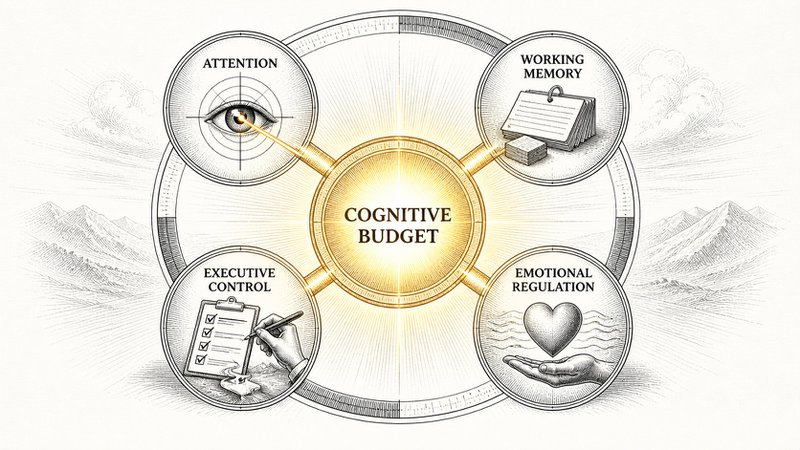
On decision-heavy days, attention cannot be left to chance. It needs care, structure, and protection. Working memory is not motivation. It is a narrow channel with real capacity limits. When you treat attention, working memory, executive control, and emotional regulation as budgets, a new form of planning becomes obvious.
You stop trying to do everything well, all day, in the same way.
Instead, you sequence the day around a harder truth: accuracy can decay, irritability can rise, mental fatigue can build, and shallow tasks can quietly steal the bandwidth your best reasoning needs.
This article gives you a practical cognitive load budgeting system for days packed with meetings, negotiations, hiring calls, board updates, complex problem-solving, high-consequence conversations, or any work where a sloppy decision becomes expensive.
If your focus regularly collapses under pressure, you may also want to read this companion guide on why focus breaks at work.
Quick answer: what is cognitive load budgeting?
Cognitive load budgeting is the practice of planning your day around the limited capacity of your attention, working memory, executive control, and emotional regulation.
Instead of treating every hour as equal, you protect your best cognitive capacity for the decisions where accuracy matters most.
In simple terms:
You do not just budget your time.
You budget your brain.
Why cognitive load budgeting matters

Most people plan high-stakes days around time.
That is necessary, but incomplete.
A calendar tells you where your hours go. It does not tell you where your cognitive capacity goes. It does not show how many small decisions, emotional interruptions, open loops, messages, meetings, and unresolved questions have already taxed your working memory.
This is why a day can look organized and still feel mentally chaotic.
You had enough time.
You did not have enough clean cognition.
Cognitive load budgeting solves a different problem. It asks:
Where should my best thinking go first?
That question matters because your brain is not one endless resource. It is several interdependent systems working together:
- attention, which lets you aim your mind
- working memory, which lets you hold and manipulate information
- inhibitory control, which helps you resist impulses and distractions
- executive control, which helps you choose, sequence, and adjust
- emotional regulation, which keeps pressure from hijacking judgment
- nervous system stability, which affects how safe, calm, or reactive your thinking feels
When these systems are taxed, decision quality suffers.
The person may still look busy.
The calendar may still look full.
The output may still look professional.
But underneath the surface, the cognitive budget is being spent in the wrong place.
The science behind the mental budget
The practical logic of cognitive load budgeting rests on a simple scientific premise: working memory is limited, and active working memory is not an infinite workspace.1Cowan, N. (2001) ‘The magical number 4 in short-term memory: A reconsideration of mental storage capacity’, Behavioral and Brain Sciences, 24(1), pp. 87–114; discussion 114–185. doi: 10.1017/S0140525X01003922. Available at: https://doi.org/10.1017/S0140525X01003922 (Accessed: 1 May 2026).
Cognitive Load Theory, originally developed by John Sweller, explains why this matters: cognitive performance depends partly on how much load is placed on limited working memory, and poor design can consume capacity that should be available for learning, reasoning, and problem-solving.2Sweller, J. (1988) ‘Cognitive load during problem solving: Effects on learning’, Cognitive Science, 12(2), pp. 257–285. doi: 10.1207/s15516709cog1202_4. Available at: https://doi.org/10.1207/s15516709cog1202_4 (Accessed: 1 May 2026). If you want a deeper entry point into the concept, read this explanation ofCognitive Load Theory, originally developed by John Sweller, explains why this matters: cognitive performance depends partly on how much load is placed on limited working memory, and poor design can consume capacity that should be available for learning, reasoning, and problem-solving.3Sweller, J. (1988) ‘Cognitive load during problem solving: Effects on learning’, Cognitive Science, 12(2), pp. 257–285. doi: 10.1207/s15516709cog1202_4. Available at: https://doi.org/10.1207/s15516709cog1202_4 (Accessed: 1 May 2026). If you want a deeper entry point into the concept, read this explanation of cognitive load theory basics.
Working memory research also shows why this matters. Cowan’s influential review argued that the focus of attention is far narrower than most people intuitively assume, often closer to about four chunks of information under many conditions (Cowan, 2001). Baddeley’s model of working memory further emphasizes that working memory is not simple storage. It is an active system involving attention, short-term holding, manipulation, and executive control (Baddeley, 2012).
Working memory research also shows why this matters. Cowan’s influential review argued that the focus of attention is far narrower than most people intuitively assume, often closer to about four chunks of information under many conditions. Baddeley’s model of working memory further emphasizes that working memory is not simple storage. It is an active system involving attention, short-term holding, manipulation, and executive control.4Baddeley, A. (2012) ‘Working memory: theories, models, and controversies’, Annual Review of Psychology, 63, pp. 1–29. doi: 10.1146/annurev-psych-120710-100422. Available at: https://doi.org/10.1146/annurev-psych-120710-100422 (Accessed: 1 May 2026).
You are deciding while:
- holding incomplete data
- tracking incentives
- managing uncertainty
- reading the room
- controlling your emotional reactions
- remembering prior commitments
- anticipating second-order effects
- avoiding premature closure
- trying not to offend the wrong person
- trying not to miss the obvious thing
This is not just “thinking.”
It is a full resource system under load.
And when the system is poorly designed, the mental load compounds.
Cognitive load budgeting vs time management vs energy management
Time management is useful.
Energy management is useful.
But neither one is precise enough for high-stakes decision-making.
| Time management | Hours and deadlines | Overbooking | Scheduling tasks |
|---|---|---|---|
| Energy management | Physical energy and motivation | Burnout | Matching work to energy levels |
| Cognitive load budgeting | Attention, working memory, executive control, and emotional regulation | Bad decisions under pressure | Protecting decision quality on complex days |
The distinction matters.
You can have time but no mental clarity.
You can have energy but poor inhibitory control.
You can be motivated but overloaded.
You can care deeply and still make a weak call because your cognitive budget has already been spent on low-value friction.
That is why cognitive load budgeting belongs in the toolkit of founders, executives, creators, clinicians, investors, strategists, operators, and anyone whose day contains important judgment under uncertainty.
Intrinsic vs extraneous cognitive load
A useful distinction sits at the center of this method: intrinsic load comes from the complexity of the task itself, while extraneous load comes from avoidable design friction.5Sweller, J., van Merriënboer, J.J.G. and Paas, F.G.W.C. (1998) ‘Cognitive architecture and instructional design’, Educational Psychology Review, 10(3), pp. 251–296. doi: 10.1023/A:1022193728205. Available at: https://doi.org/10.1023/A:1022193728205 (Accessed: 1 May 2026).
Intrinsic cognitive load
Intrinsic cognitive load is the load built into the task itself.
Examples:
- weighing tradeoffs in a pricing change
- diagnosing a complex operational failure
- negotiating terms with asymmetric information
- making a hiring decision with limited signal
- deciding how to allocate money, attention, or people under uncertainty
- choosing between two options when neither is clean
You cannot hack intrinsic load away.
Some decisions are hard because they are hard.
The goal is not to pretend otherwise. The goal is to protect enough cognitive capacity to meet the task properly.
Extraneous cognitive load
Extraneous cognitive load is the load created by poor design.
Examples:
- unclear agendas
- decisions without criteria
- meetings without pre-reads
- switching contexts every 20 minutes
- hunting for files, numbers, or old notes live on a call
- re-litigating decisions because they were never properly closed
- trying to remember everything instead of externalizing it
- entering a negotiation without a walk-away point
- asking your brain to hold what a system should hold
Extraneous load is optional, but it is everywhere.
It is the tax you pay for poor structure.
A high-stakes day becomes dangerous when extraneous load consumes the capacity you needed for intrinsic load. You still feel busy, but you are busy in the wrong way.
Your brain needs a budget the way your finances do
A money budget protects your finances from invisible leakage.
A cognitive budget protects your brain from invisible leakage.
Most people understand that smaller expenditures can quietly damage a financial budget. A subscription here. A convenience purchase there. A few untracked expenses. Nothing seems catastrophic in isolation, but the pattern eventually matters.
The same thing happens with cognition.
A quick email.
A small decision.
A low-value meeting.
A message thread that should have been closed.
A minor conflict that keeps looping in the background.
Each one may look harmless. Together, they create mental load.
This is why better money decisions and better decision-making under pressure follow a similar logic: you must know what the real budget is, what matters most, and what must not be spent casually.
Your cognitive budget is not infinite.
Treating it as infinite is how high-stakes days quietly break.
Most people schedule decision days based on external constraints:
- who is available
- what the calendar looks like
- which meeting got booked first
- what someone else marked urgent
- what feels easiest to start
That is understandable.
But it creates a compounding effect:
- You start with low-grade chaos: messages, minor calls, quick decisions.
- Your working memory gets fragmented.
- You enter the hardest meeting already partially depleted.
- You make a “good enough” decision.
- Later, you redo it, explain it, defend it, or repair it.
- Now the day is heavier, not lighter.
This is why high-stakes days often feel like they accelerate toward disorder.
Cognitive load budgeting flips the sequence.
It asks one question first:
When do I need my cleanest thinking?
Then it builds protection around that window.
If you want to strengthen the attention side of this problem, this guide on how to train your attention filter gives a useful supporting frame.
The core rule: protect one deep reasoning block first
If you do only one thing differently, do this:
Schedule one protected deep reasoning block early in the day, before meetings multiply.
This block is not for catching up on email.
It is not for Slack.
It is not for “quick admin.”
It is where you prepare the mental architecture of the day.
Use it to:
- clarify the real decision or decisions you must make
- define criteria before social pressure enters the room
- identify risks and second-order effects
- prepare negotiation boundaries
- pre-write the one-page you wish you had during the meeting
- list the questions you must not forget to ask
- externalize complexity before it clutters working memory
This is where mind mapping the decision can help. A good mind map moves complexity out of your head and onto the page. That does not make the decision easy, but it reduces unnecessary mental load.
For founders and leaders, this is often the difference between driving the day and being driven by it.
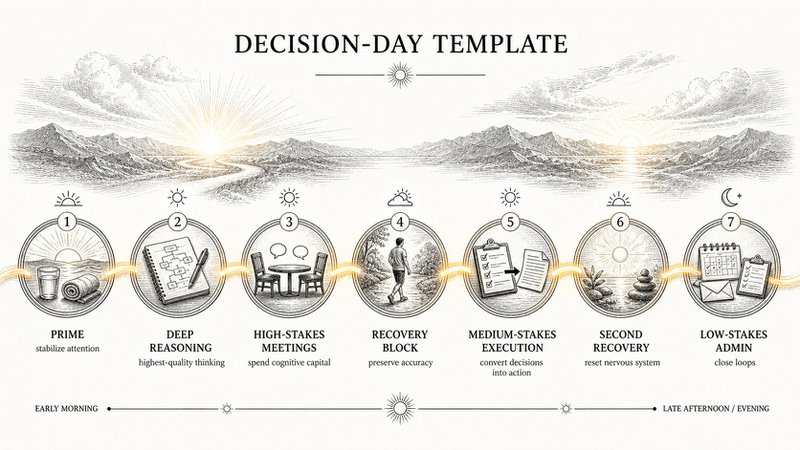
The cognitive load budgeting template
Use this as a starting structure.
Adjust it for your reality, but keep the logic.
| Prime | 60 to 90 minutes | Stabilize attention | Light movement, hydration, simple start ritual, quick scan of the day | News, social media, reactive messaging |
|---|---|---|---|---|
| Deep reasoning | 90 to 120 minutes | Highest-quality thinking | Criteria, pre-mortem, key numbers, draft decisions, write questions | Meetings, Slack ping-pong, quick calls |
| High-stakes meetings | 2 to 4 hours | Spend cognitive capital | Negotiations, hard conversations, technical reviews | Unnecessary context switching |
| Recovery block | 20 to 45 minutes | Preserve late-day accuracy | Walk, meal, downshift, notes cleanup | Squeezing in “just one more meeting” |
| Medium-stakes execution | 60 to 120 minutes | Convert decisions into action | Delegations, brief follow-ups, documentation | Re-opening decisions without new information |
| Second recovery | 15 to 30 minutes | Reset the nervous system | Low stimulation, breathing, sunlight | Caffeine stacking, chaotic multitasking |
| Low-stakes admin | 30 to 60 minutes | Close loops | Scheduling, lightweight email, operational cleanup | High-consequence decisions |
This template works because it respects the order of cognitive demand.
First, you stabilize.
Then, you think.
Then, you decide.
Then, you recover.
Then, you execute.
Then, you close loops.
That order protects decision quality better than a calendar built only around availability.
Three fast-acting tools to boost focus, energy, and discipline in the next 72 hours.
Step 1: front-load the hardest reasoning
There is a subtle psychological problem in meeting-heavy days.
Once you start talking to people, their priorities, fears, incentives, and narratives enter your working memory.
That social load is real.
It is not weakness.
It is cognition.
So give yourself a protected block before the first major meeting and answer these five questions:
- What decision must be made today, in one sentence?
- What does “good” mean?
- What tradeoff am I willing to accept?
- What tradeoff am I not willing to accept?
- What is the one thing I must not forget to ask?
If you walk into high-stakes rooms without those answers, you may borrow them from the room.
That is how weak decisions happen.
You mistake pressure for clarity.
You mistake confidence for evidence.
You mistake relief for resolution.
A better method is simple: prepare the frame before the room starts shaping it for you.
If your mind tends to carry too many open loops into the day, use journaling to clear mental clutter fast before the first major decision.
Step 2: pre-commit decision criteria
Most decision fatigue comes from a specific pain.
You are not just deciding.
You are deciding how to decide while the clock runs and people watch.
That is expensive.
Pre-commit criteria while you are calm.
Here is a simple format you can copy into your notes.
Decision criteria card
Decision:
What is the actual decision?
Must-have criteria:
1._________________
2._________________
3._________________
Nice-to-have criteria:
1._________________
2._________________
3._________________
Deal-breakers:
1._________________
2._________________
Default if unclear:
Delay, delegate, run a test, choose the conservative option, or gather more data.
Revisit trigger:
What new information would justify changing the decision?
This card does two things.
First, it reduces extraneous cognitive load during the meeting.
Second, it protects you from persuasive energy that feels like clarity but is actually social pressure.
This is cognitive load budgeting in practice: you spend your best thinking before the room becomes noisy.
Step 3: use checklists for repeatable judgments
Checklists are not for beginners.
They are for anyone doing repeatable high-stakes work.
If you make similar judgments often, build a checklist once and stop re-deriving it from scratch.
A checklist does not remove thinking.
It removes avoidable forgetting.
That matters because forgetfulness under pressure is not always a memory problem. Often, it is a design problem. The brain is being asked to hold too much, too late, while also managing stakes, people, emotion, and uncertainty.
If you want more support here, this guide on how to reduce forgetting under pressure is a useful companion.
Negotiation checklist
- What is my best alternative if this fails?
- What is my walk-away point?
- What am I optimizing for: price, time, risk, relationship, or optionality?
- What information am I missing?
- What would I regret conceding tomorrow?
Hiring decision checklist
- What problem is this role solving in the next 6 months?
- What does “excellent” look like in observable behavior?
- What is the strongest disconfirming evidence?
- What is the cost of a false positive versus a false negative?
- What reference question will reveal the truth fastest?
Critical change checklist
- What breaks if we are wrong?
- How reversible is this decision?
- What is the smallest test that reduces uncertainty?
- Who needs to be informed to prevent downstream confusion?
- What is the rollback plan?
This is where a cognitive budget becomes operational.
You stop paying the same mental tax over and over.
Step 4: treat recovery blocks as accuracy insurance
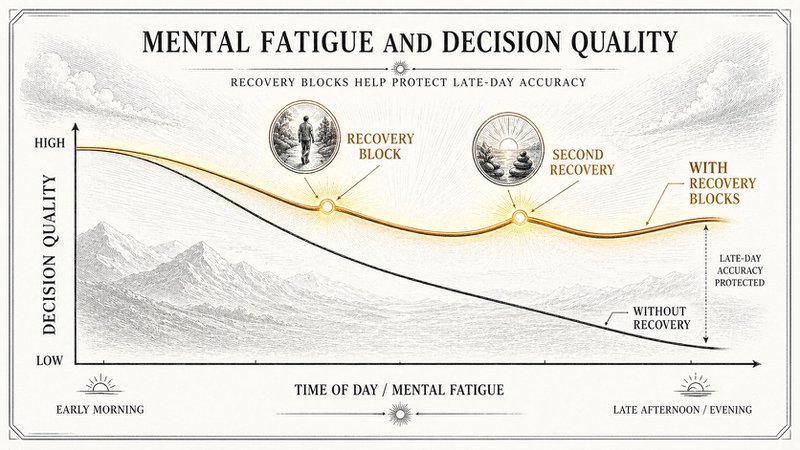
Recovery blocks are not indulgence on a decision day.
They are accuracy insurance.
Without recovery, the brain can shift into a mode where:
- nuance collapses
- risk tolerance skews
- irritability rises
- inhibitory control weakens
- mental fatigue increases
- you become more impulsive or more avoidant
- you default to “let’s just do it” or “let’s delay it”
Both patterns are expensive.
Research on mental fatigue suggests that demanding cognitive tasks can impair emotion regulation, which matters because emotion regulation is part of how leaders remain precise under pressure.6Grillon, C., Quispe-Escudero, D., Mathur, A. and Ernst, M. (2015) ‘Mental fatigue impairs emotion regulation’, Emotion, 15(3), pp. 383–389. doi: 10.1037/emo0000058. Available at: https://doi.org/10.1037/emo0000058 and https://pmc.ncbi.nlm.nih.gov/articles/PMC4437828/ (Accessed: 1 May 2026). In high-stakes clinical settings, decision fatigue has also been studied as a contributor to impaired judgment and inconsistent decision-making, although the size and mechanisms of the effect vary by context.7Grignoli, N., Manoni, G., Gianini, J., Schulz, P., Gabutti, L. and Petrocchi, S. (2025) ‘Clinical decision fatigue: a systematic and scoping review with meta-synthesis’, Family Medicine and Community Health, 13(1), e003033. doi: 10.1136/fmch-2024-003033. Available at: https://doi.org/10.1136/fmch-2024-003033 and https://pmc.ncbi.nlm.nih.gov/articles/PMC11808891/ (Accessed: 1 May 2026).
The practical point is not that every late-day decision is bad.
The point is that tired brains need better safeguards.
What a real recovery block looks like
A real recovery block is short, low stimulation, and physically downshifting.
Options:
- a 15 to 30 minute walk outside
- a quiet meal without screens
- 5 minutes of eyes-closed breathing plus a slow stretch
- a simple notes cleanup that closes open loops
- a few minutes of breath-guided biofeedback
- sunlight and easy movement between meetings
This is not self-care language.
This is decision-quality language.
If physiology is part of your performance system, use tools that help you biofeedback to downshift stress or build HRV and decision resilience. If your nervous system is carrying deeper tension, you may also benefit from methods that help you reset the nervous system.
What recovery is not
Recovery is not:
- scrolling
- arguing in comments
- checking metrics every 10 minutes
- doing “light admin” that becomes more decisions
- squeezing in another meeting because it is only 15 minutes
- stacking caffeine because you refused to downshift earlier
If you want one principle, use this:
Treat recovery as the thing that preserves judgment.
Step 5: build friction against late-day high-stakes choices
Late-day decisions are where errors hide.
Not because you are incompetent.
Because your cognitive budget is low and you are more likely to accept a false sense of closure.
Add a simple rule:
No irreversible decisions after X time, unless they were pre-framed in the morning block.
Pick a time that matches your rhythm.
For many people, 3:00 pm is a meaningful turning point. For others, the turning point is earlier or later. The exact time matters less than the principle: do not pretend every hour has the same decision quality.
If a decision is truly urgent late in the day, you can still make it.
But you should be able to answer:
- Did I define criteria earlier?
- Do I have the key numbers in front of me?
- Am I choosing because this is correct, or because I want relief?
- What would I think about this tomorrow morning?
- Is this reversible?
- What is the cost of waiting?
That third question is uncomfortable.
That is why it works.
A note for neurodivergent individuals and ADHD-style budgeting
For neurodivergent individuals, including many adults with ADHD, the idea of a mental budget may feel immediately familiar.
The issue is not always lack of care.
Often, the issue is that working memory, task initiation, prioritization, emotional regulation, sustained attention, and inhibitory control are already under heavier demand. CHADD describes executive function as the brain’s ability to activate, organize, integrate, and manage other functions, including planning, evaluating actions, and adjusting behavior.8Children and Adults with Attention-Deficit/Hyperactivity Disorder (CHADD) (n.d.) ‘Executive Function Skills’. Available at: https://chadd.org/about-adhd/executive-function-skills/ (Accessed: 1 May 2026).
That matters because cognitive load budgeting is not just a productivity trick.
It can become a support structure.
For neurodivergent adults, the practical moves are often even more important:
- externalize the decision
- reduce open loops
- use visible criteria
- reduce hidden steps
- lower context switching
- create recovery before collapse
- make the next action obvious
- use checklists before motivation is required
- separate high-stakes decisions from cluttered environments
This is not a replacement for diagnosis, treatment, coaching, or clinical support.
But as a planning method, cognitive load budgeting can help protect the mental budget from being spent invisibly before the important work begins.
The goal is not to force the brain harder.
The goal is to design the day with more intelligence.
A realistic high-stakes decision day
Here is what cognitive load budgeting looks like when the calendar is not ideal.
Morning
You wake up and your first instinct is to check messages.
Instead, you protect your bandwidth for 45 minutes.
You write:
- the 2 decisions that matter today
- the criteria cards
- the questions you must ask in each meeting
- the walk-away points for the negotiation
- the risk you are most likely to ignore
- the one thing you must not decide emotionally
Now your mind is not a collection of open tabs.
It is a prepared system.
Midday
Meetings happen.
People push.
New information appears.
You capture it in a running note, but you do not try to resolve everything live.
You are looking for:
- what changed the criteria
- what confirmed the path
- what created a new risk
- what needs more data
- what can wait
Then you take a short walk and eat.
That recovery block is what makes your last meeting feel sharp instead of brittle.
Late afternoon
You shift to execution:
- document decisions
- assign owners
- close loops
- schedule follow-up
- send the summary
- protect tomorrow’s first thinking block
You avoid opening new fronts that demand deep reasoning when your budget is low.
You end the day with fewer loose ends, not more.
That is the compounding benefit of cognitive load budgeting.
Fewer rework cycles.
Fewer avoidable misunderstandings.
Fewer late-day decisions made for emotional relief.
More clean thinking where it matters.
When cognitive load budgeting helps most
Use this method when the day includes:
- high-stakes decision-making
- negotiations
- hiring or firing decisions
- board updates
- investor calls
- strategic planning
- emotionally charged conversations
- legal or financial decisions
- complex technical reviews
- medical, clinical, or care-related judgment
- creative work that requires sustained attention
- any situation where uncertainty is high and the cost of error is real
This method is especially useful when the day combines intellectual complexity with emotional load.
That combination is where many high performers underestimate the real cost.
They plan for the task.
They forget to plan for the state required to perform the task well.
Quick diagnostic: are you overspending your cognitive budget?
If any of these are true, your next decision day will benefit from this method:
- You often realize what you think during the meeting, not before it.
- You reopen the same decision multiple times in a week.
- You leave key meetings mentally foggy.
- You need 30 minutes to recover after routine calls.
- You make avoidable mistakes late in the day.
- You struggle to remember what was agreed and why.
- You feel unusually reactive after too much context switching.
- You say yes too quickly when tired.
- You delay decisions because the day feels mentally noisy.
- You confuse busyness with progress.
- You keep making the same category of decision from scratch.
Those are not character flaws.
They are signals that the day is not designed around cognitive limits.
The simplest way to start
Do not rebuild your entire calendar first.
Start with one high-stakes day.
Try this:
- Block 60 to 90 minutes early for deep reasoning.
- Write one criteria card for the most important decision.
- Create one checklist for the repeatable judgment you will make that day.
- Schedule one recovery block before the last major meeting.
- Set one late-day decision boundary.
- End with a written closure note.
That is enough to feel the difference.
Not as motivation.
As clean thinking, steadier nerves, and fewer costly second guesses.
For a broader reset of your attention system, use the 72-hour focus reset. If you want a low-friction starting point, get the free Atlas Focus Kit.
Cognitive load budgeting FAQ
What is cognitive load budgeting?
Cognitive load budgeting is the practice of planning your day around the limited capacity of your attention, working memory, executive control, and emotional regulation. It helps you protect your best cognitive capacity for the decisions where accuracy matters most.
How do you budget cognitive load on a high-stakes day?
Start by identifying the most important decisions of the day. Then schedule your deepest reasoning block before meetings, define decision criteria early, use checklists for repeatable judgments, add recovery blocks, and avoid irreversible late-day decisions unless they were framed earlier.
What is the difference between cognitive load budgeting and time management?
Time management budgets hours. Cognitive load budgeting budgets mental capacity. A calendar can show when meetings happen, but it does not show whether your working memory, sustained attention, inhibitory control, and emotional regulation are already depleted.
Why do decision-heavy days cause mental fatigue?
Decision-heavy days create mental fatigue because they repeatedly tax attention, working memory, executive control, uncertainty management, and emotional regulation.9Baddeley, A. (2012) ‘Working memory: theories, models, and controversies’, Annual Review of Psychology, 63, pp. 1–29. doi: 10.1146/annurev-psych-120710-100422. Available at: https://doi.org/10.1146/annurev-psych-120710-100422 (Accessed: 1 May 2026); Grillon, C., Quispe-Escudero, D., Mathur, A. and Ernst, M. (2015) ‘Mental fatigue impairs emotion regulation’, Emotion, 15(3), pp. 383–389. doi: 10.1037/emo0000058. Available at: https://doi.org/10.1037/emo0000058 (Accessed: 1 May 2026). The issue is not only the number of decisions, but the cumulative mental load created by switching, ambiguity, pressure, and unresolved loops.
What is extraneous cognitive load?
Extraneous cognitive load is unnecessary mental load created by poor structure. Examples include unclear agendas, missing pre-reads, decisions without criteria, live file-hunting during meetings, poor documentation, and repeated context switching.
How can leaders reduce cognitive load before important meetings?
Leaders can reduce cognitive load by clarifying the real decision, writing criteria, preparing key numbers, defining walk-away points, listing risks, sending pre-reads, and using a checklist before the meeting starts. This protects working memory for judgment, not basic orientation.
Does cognitive load budgeting help neurodivergent individuals?
It can help many neurodivergent individuals because it externalizes decisions, reduces hidden steps, protects working memory, and lowers unnecessary context switching. It is not medical treatment, but it can be a practical support structure for attention, planning, and emotional regulation.
When should you avoid making high-stakes decisions?
Avoid irreversible high-stakes decisions when you are mentally fatigued, emotionally reactive, underfed, sleep-deprived, missing key information, or choosing mainly to feel relief. If the decision is urgent, use pre-written criteria, key numbers, and a second reviewer where possible.
Final principle
You do not rise to the level of your intentions on a high-stakes day.
You fall to the structure protecting your cognition.
Cognitive load budgeting gives that structure a name.
It helps you protect the mental budget behind better decisions, steadier leadership, and deeper work.
The standard is simple:
Do not spend your best brain on low-value noise, then ask what remains to carry the weight of your life.
Protect the cleanest thinking.
Spend it where it matters.
Close the loops.
Recover before accuracy breaks.
That is how you turn a high-stakes day from a cognitive hazard into a designed system.
Enter your email and get instant access to three practical tools you can apply in 10 minutes.

