
A personal project can stay unfinished for years while you work hard every day for someone else.
You meet obligations, solve problems and carry responsibilities. Yet the thing you chose for yourself remains in a folder, in a notebook, in the back of your mind. Whenever you return to it, you see how much it could become. You add another idea. Then you run out of time again.
If you want to finish it alongside a full-time job, begin by deciding what a useful finished version will do. Cut everything that does not serve that version, give the next action a realistic place in your week, and choose a date to put the result to use or get feedback. Keep a smaller action ready for a disrupted day.
The time constraint is real. But before you try to find another hour, give that hour somewhere to take you.

Give your project a finish line you can recognise
“Finish my project” can conceal several different ambitions. You might want to make something useful, learn a skill, express an idea, preserve a memory or prove to yourself that you can follow through. Those aims deserve different finish lines.
Suppose you have been collecting family recipes. You want a relative who has moved into their own home to be able to cook a few familiar dishes. Over time, the idea has grown: photographs, family stories, a beautiful cover, perhaps a printed book. Each addition is attractive. Together, they have made the project much harder to finish.
Return to the person you wanted to help. What must exist for them to benefit?
A first useful version could be three recipes in one readable document, with quantities, steps and cooking times. The test is whether your relative can follow the instructions without calling you to fill in something you forgot. Photography can wait. A missing oven temperature cannot.
That distinction tells you what quality means for this version. You can take great care with the part that matters while deliberately leaving other possibilities for later. A smaller promise, properly fulfilled, is a real achievement.
Write your own finish definition in this form:
This version is finished when [the person, including me] can [do or experience something specific] using [the result], and I have checked [what must work].
For a personal essay, that might mean a complete argument you have revised and shared with the people it is for. For a repaired piece of furniture, it might mean that it is safe, stable and back in use. For a piece of music, it might mean a recording that expresses the arrangement you chose. You decide what the work is meant to accomplish. Then give that decision a boundary.
Write a second line: This version will not include ______. Put the most tempting extra there. If you cannot bear to omit anything, you are still defining the whole ambition, rather than the version you are going to finish.
Create the structure the project is missing
At work, a brief, a colleague or a delivery date may help establish what has to happen next. Some jobs provide very little useful structure. Either way, your personal project needs its own answer to three questions: what am I completing, when will I use or show it, and how will I know what needs to change?
The fact that nobody is paying you to do it does not make it unimportant. A piece of music, a family record or something made with your own hands can deserve your full seriousness. When nobody supplies the conditions that help it progress, we have to build those conditions ourselves.
A deadline is only part of that structure. What is there in the finished work that makes you want to return to it? For the recipe maker, it is the thought of a familiar meal being cooked in another home. That gives the work a purpose beyond crossing a task off a list. Keep that purpose close enough to see, alongside the date. You need a reason to move towards the result as well as a limit on how long you will leave it unfinished.
Give the recipe project a first feedback date: the Sunday after your first two sessions, your relative will read one recipe and, when convenient for them, try cooking it. Ask a useful question: “Where did you have to guess?” That answer is much more helpful than whether they like the idea of your book.
Use the first completed recipe to estimate the remaining work. Allow for the other recipes, their checks and the final document. Suppose that work will fit into four more protected sessions. At two sessions a week, you set the finish for the second Thursday after the review. This is a provisional estimate, checked against work you have actually done. If the work will not fit, reduce the version or move the date. Writing an ambitious date beside an impossible workload does not make the plan stronger.
You do not need an audience for every project. If it is private, choose your own review: play the recording from beginning to end, read the completed essay aloud, or use the thing you have made. The point is to encounter the result, so you can respond to something more substantial than your intention.
Put the work inside the life you already have
Look at the coming week before choosing a work rhythm. Include your job, travel, care, household responsibilities, relationships and recovery. The blank spaces on a calendar are not necessarily available energy.
For our example, suppose Tuesday and Thursday from 8:15 to 9 p.m. are genuinely available. Those two sessions replace television on those evenings. They do not replace time already promised to a partner, and they end before the person’s usual preparation for bed. That is 90 minutes of project work in the week, with a clear cost and a clear boundary.
Your week may offer a different arrangement: one weekend session, a quiet lunch break using your own equipment, or a shorter period after work. Choose it from your actual circumstances. If there is no reasonable space this week, move the project deliberately to a date when you can reconsider it. Do not call yourself undisciplined for refusing to fund a hobby with exhaustion.
Now put a task inside the session. On Tuesday, the recipe maker will write the quantities and instructions for one selected dish, check the gaps, and leave it ready for another person to read. There is no need to choose new software or redesign the whole document first.
An if–then plan makes the start concrete: “If it is 8:15 on Tuesday and the household responsibilities are finished, I will open the recipe document at the kitchen table and write the quantities for the soup.” Research on implementation intentions supports connecting a specific situation with a planned action to help people pursue their goals. It does not guarantee that a particular project will be completed.1Gollwitzer, P.M. and Sheeran, P. (2006) ‘Implementation intentions and goal achievement: A meta-analysis of effects and processes’, Advances in Experimental Social Psychology, 38, pp. 69–119. https://doi.org/10.1016/S0065-2601(06)38002-1. The review supports if–then planning across varied goals; the project plan and example in this article are practical applications, not a separately tested method.
Before ending the session, leave the next physical action in the document: “Check the rice quantity, then write the final three steps.” When you return, you should be able to begin the work without first reconstructing what you were doing.
Decide what happens when the week goes wrong
A plan that depends on every evening going well leaves you with a difficult choice as soon as life interrupts it. Either you abandon the plan or you try to recover the lost time from somewhere else.
Choose a smaller useful action in advance. If Tuesday’s session disappears, perhaps Thursday still offers ten minutes. You could resolve the missing quantity and correct that part of the recipe. The document is now closer to being usable. Watching another video about making recipe books would not accomplish the same thing.
Ten minutes is an example, not an obligation. Some tasks need a longer uninterrupted period to be done safely or well. For those, the smaller action might be preparing the materials for the next proper session. Record it honestly as preparation. Do not confuse keeping in contact with a project with completing the work it requires.
And some disrupted weeks have no sensible fallback. A sick child, an urgent obligation or your own need for recovery can take the time you intended to use. Move the next session, adjust the finish date if necessary, and leave a clear note about where to resume. You have made a decision about competing responsibilities. There is no value in turning it into a verdict on your character.
Review what exists, then finish, simplify or stop
Once a week, look at the work itself. What is now finished? What did using it reveal? What remains between this version and the finish definition?
Suppose your relative tries the soup and finds the instructions clear, except that the recipe never says whether to cover the pan. Add that instruction. Suppose they also suggest photographs of every stage. Ask whether those images are necessary to cook it successfully. A suggestion can be good and still belong in a later version.
The review also tells you whether your schedule was realistic. If both evening sessions repeatedly disappear, examine why. Perhaps they depend on household tasks ending earlier than they usually do. Change that arrangement before making another promise to work harder. A plan gives you something to compare with reality, and that comparison helps you make the next plan more intelligent.
There is also an honest reason to stop. If your relative really wants one recipe card, and you no longer want to make the booklet for its own sake, finish the useful card and release yourself from the larger project. Effort already spent is no reason to keep creating something neither of you wants.
When your relative can cook from the first recipe, recognise that as a completed part of the work. You set out to preserve something and make it useful, and now one piece of it is being used. That result gives you something concrete to build on when you sit down for the next session. If you only look at everything still missing from the imagined book, you overlook the progress that could help you continue.
When the chosen version meets its finish definition, close it. Share it, use it, put it on the shelf. Keep future improvements on a separate list. Let yourself recognise what you have actually achieved before converting it into another unfinished obligation.
Make your finish plan
Here is the recipe example reduced to the decisions that govern the work. Its session lengths and dates are illustrative; yours must fit your project and your life.
| Decision | Worked example |
|---|---|
| Who it is for | A relative who wants to cook three familiar dishes. |
| Useful finished version | One readable document with three complete recipes, checked for missing quantities and instructions. |
| Acceptance check | The intended reader can follow each of the three recipes without guessing at an essential step. |
| Deliberately left out | Custom photography, family history and a printed edition. |
| Next physical action | Write the soup’s ingredient quantities in the existing document. |
| Full session | Tuesday and Thursday, 8:15–9 p.m., replacing television and ending on time. |
| Disrupted-week fallback | Use an available ten minutes to resolve one missing quantity; otherwise move the session and date. |
| Feedback and finish date | Show one recipe the Sunday after the first two sessions. If four more sessions cover the remaining work, finish on the second Thursday after that review. |
| Weekly decision | Finish the necessary instructions; defer extras; stop the booklet if a single card fulfils the real purpose. |
Copy these lines into the place where you keep the project:
This matters to me because: ______
This version is finished when: ______
It will not include: ______
My next physical action is: ______
I will do it at this time and place: ______
It replaces: ______
If that session is disrupted, I will: ______
I will use or show the result on: ______
My finish date, checked against the work remaining, is: ______
Fill in the finish definition and the next session now. You do not need to solve every future problem before doing the part you can already see.
An achievement is a moment. The life you live while working towards it matters too. Finish the thing you chose, take pleasure in what you have made, and let the people and commitments you care about keep their place along the way.
3-Day Atlas Accelerator
Your project deserves more than another year in a folder.
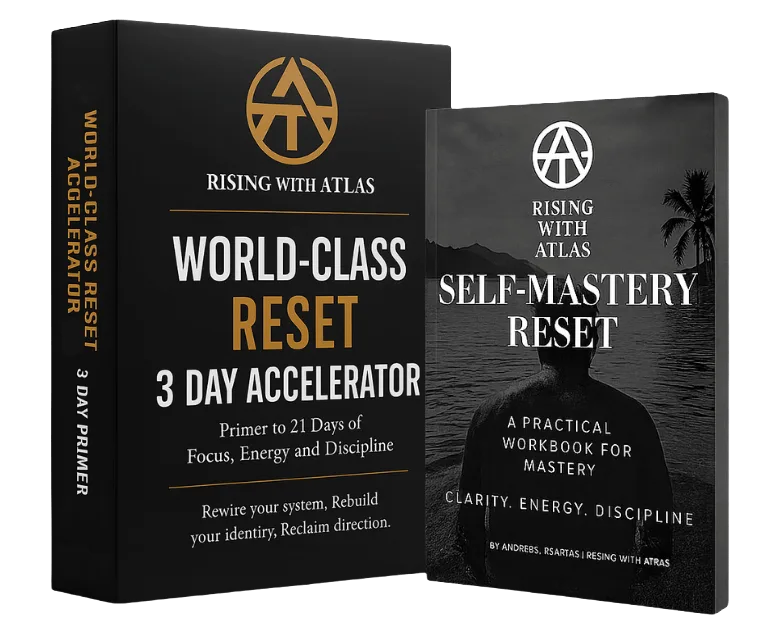
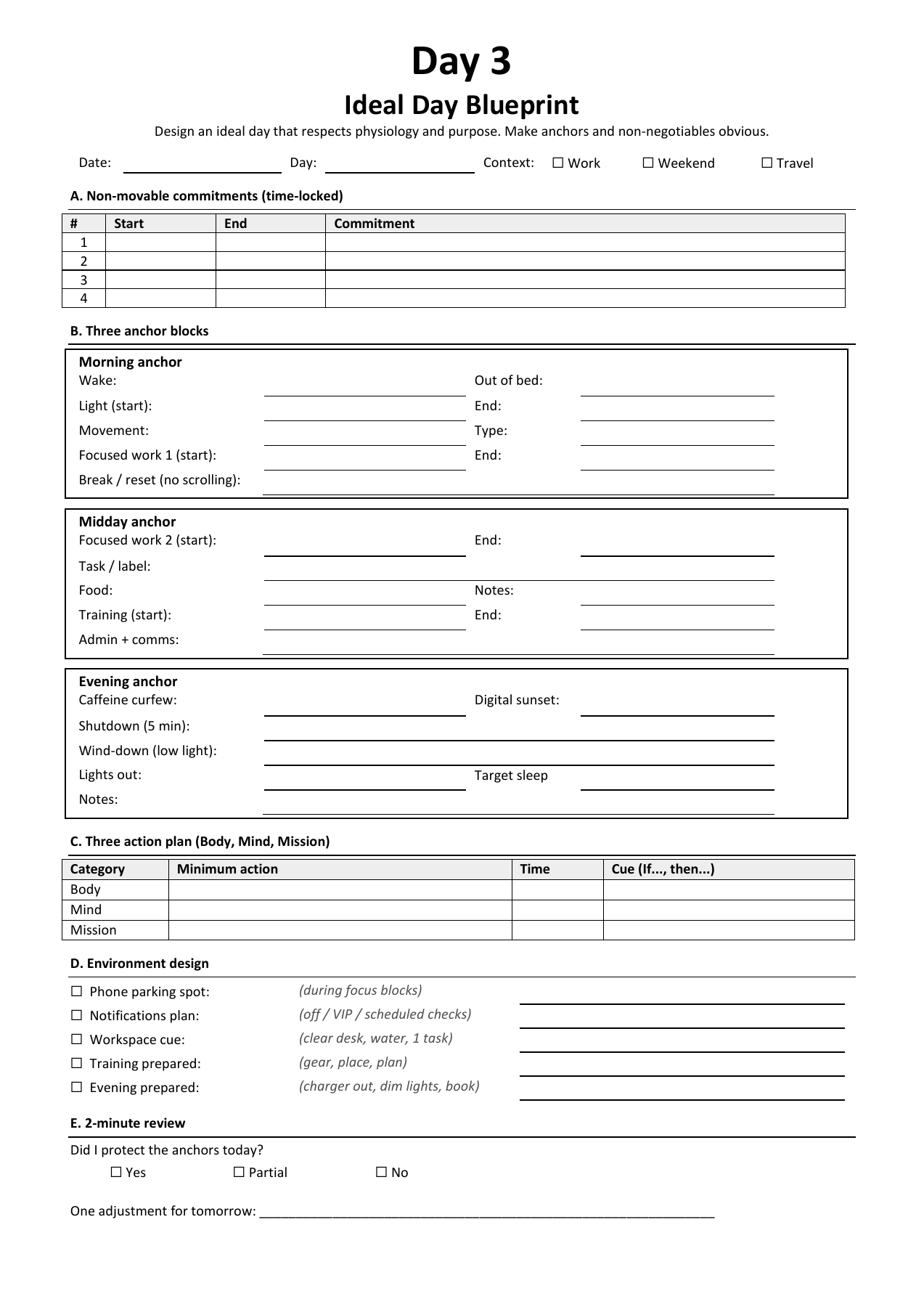
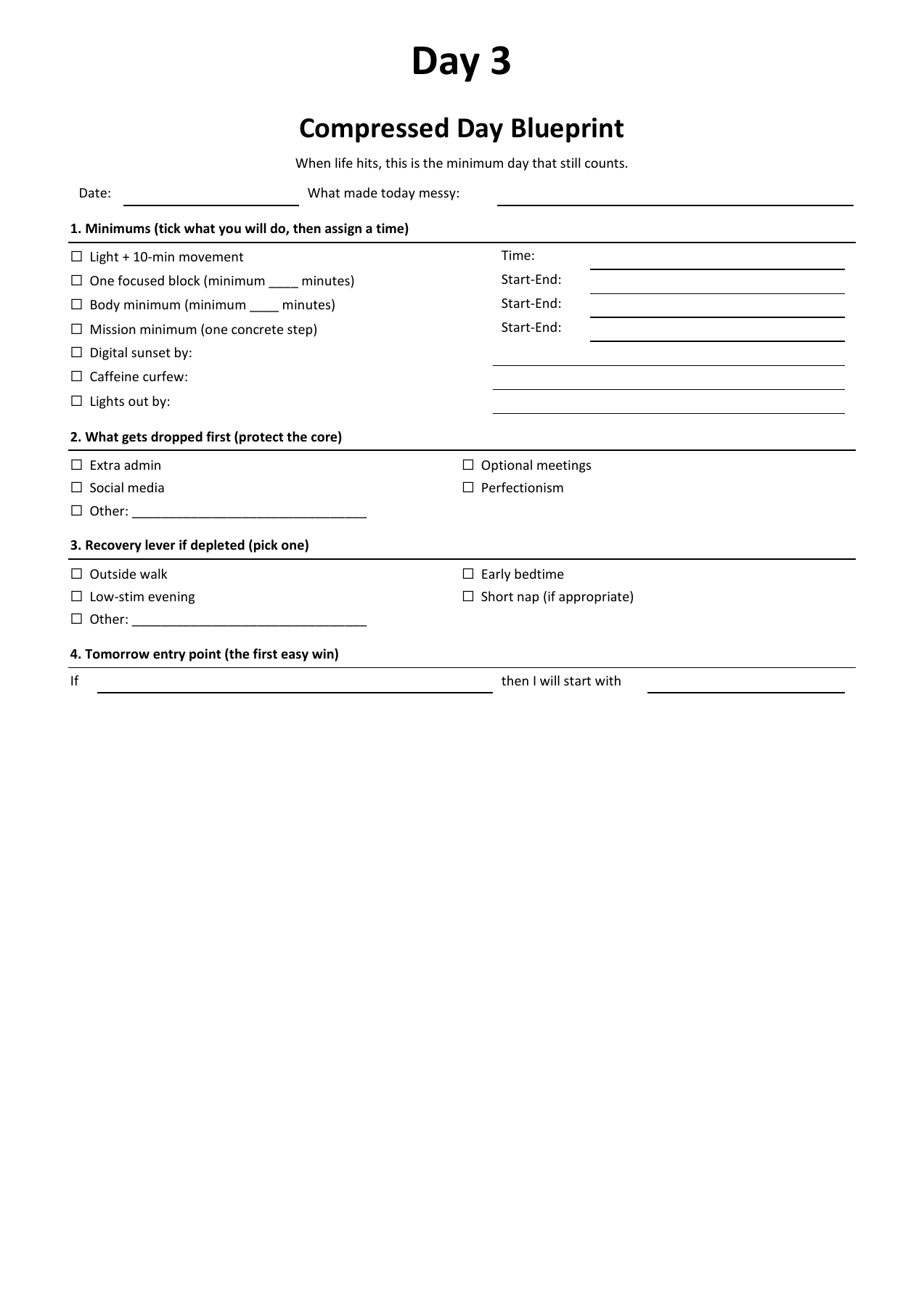
Give the work you care about a place in your day. The 3-Day Atlas Accelerator helps you build your Ideal Day, remove friction and create a Compressed Day for when life interrupts.
US$47 · One-time payment
Start my 3-day resetSelf-paced · Workbook included · 14-day money-back guarantee
Try a real course exercise“This course helped me make more progress in 3 days than I made in the last 3 years.”
See what you will use.
The actual course worksheets. Select either page to read it.
If you would prefer more practical essays before taking a course, you can join Rising with Atlas free. For more work on turning intention into contribution, explore Leadership and contribution.