



Do power poses work? Yes, but only when you stop asking them to do the wrong job.
The weak claim is that a two-minute posture can reliably rewrite your hormones, make you dominant, and turn fear into confidence on command. That is the internet version. It is too clean, too dramatic, and too certain.
The stronger claim is better: posture is one input into state. It can change how you breathe, how you sense yourself, how ready you feel, how much you collapse, how much you brace, and how easily you move into action. The hormone literature is debated. The posture-to-state loop is harder to dismiss.1Carney, D.R., Cuddy, A.J.C. and Yap, A.J. (2010) 'Power posing: brief nonverbal displays affect neuroendocrine levels and risk tolerance', Psychological Science, 21(10), pp. 1363-1368. Available at: https://doi.org/10.1177/0956797610383437; Ranehill, E., Dreber, A., Johannesson, M., Leiberg, S., Sul, S. and Weber, R.A. (2015) 'Assessing the robustness of power posing: no effect on hormones and risk tolerance in a large sample of men and women', Psychological Science, 26(5), pp. 653-656. Available at: https://doi.org/10.1177/0956797614553946; Körner, R., Röseler, L., Schütz, A. and Bushman, B.J. (2022) 'Dominance and prestige: Meta-analytic review of experimentally induced body position effects on behavioral, self-report, and physiological dependent variables', Psychological Bulletin, 148(1-2), pp. 67-85. Available at: https://doi.org/10.1037/bul0000356; Barel, E., Shahrabani, S., Mahagna, L., Massalha, R., Colodner, R. and Tzischinsky, O. (2024) 'The effects of power posing on neuroendocrine levels and risk-taking', BMC Psychology, 12, 726. Available at: https://doi.org/10.1186/s40359-024-02194-7.
That distinction matters. If you sell power poses as a hormone hack, the evidence pushes back. If you use them as a low-cost state-entry ritual before pressure, the practice becomes honest, useful, and immediately testable.
Your body is not a carrying case for your mind. It is one of the places your mind becomes visible.
Do power poses work? The real answer
Power poses can work as a practical state-regulation tool, especially when the goal is to reduce collapse, open breathing, increase readiness, and enter action with more physical coherence. They should not be marketed as a guaranteed way to change testosterone or cortisol.
- Best-supported use: use posture to reduce contraction, support breathing, and shift subjective state before pressure.
- Most defensible benefit: upright or expansive posture may influence mood, self-perception, confidence and stress appraisal.
- Most useful correction: do not chase theatrical dominance. Start by refusing collapse.
- Weakest claim: power poses reliably produce immediate hormone changes across people and contexts.
- Practical move: use a 60 to 120 second posture reset before meetings, interviews, calls, workouts, presentations or difficult conversations.
What are power poses?
Power poses are open, expansive body positions associated with confidence, readiness or social power. The familiar versions include standing with hands on hips, lifting the arms into a victory shape, sitting tall with the chest open, or taking a stable stance with the feet planted and the gaze lifted.
The popular idea became famous because the original research suggested that brief expansive postures could increase feelings of power, increase risk tolerance, raise testosterone and reduce cortisol. That was a remarkable promise. It was also the part of the story that later became most contested.2Carney, D.R., Cuddy, A.J.C. and Yap, A.J. (2010) 'Power posing: brief nonverbal displays affect neuroendocrine levels and risk tolerance', Psychological Science, 21(10), pp. 1363-1368. Available at: https://doi.org/10.1177/0956797610383437; Ranehill, E., Dreber, A., Johannesson, M., Leiberg, S., Sul, S. and Weber, R.A. (2015) 'Assessing the robustness of power posing: no effect on hormones and risk tolerance in a large sample of men and women', Psychological Science, 26(5), pp. 653-656. Available at: https://doi.org/10.1177/0956797614553946.
The pose is not the point. The point is the state you enter action from.
Through the lens of the Self Matrix, posture is not merely body language. It is one of the bridges between the physical self and the cognitive self. Your posture changes the conditions under which thought, breath, attention and action meet.
Do power poses work according to the research?
Do power poses work? The evidence says: partly, conditionally, and more strongly for subjective state than for hormones.
The original power-pose study reported effects on felt power, risk tolerance, testosterone and cortisol. A larger 2015 replication found an effect on self-reported feelings of power but did not find significant effects on hormones or risk-taking. Later reviews and meta-analytic work suggest that self-report outcomes are more plausible than broad physiological effects. A 2024 replication and extension did not replicate testosterone or felt-power effects, although it reported partial findings around cortisol, risk-taking and exploratory estradiol effects under specific hormonal conditions.3Ranehill, E., Dreber, A., Johannesson, M., Leiberg, S., Sul, S. and Weber, R.A. (2015) 'Assessing the robustness of power posing: no effect on hormones and risk tolerance in a large sample of men and women', Psychological Science, 26(5), pp. 653-656. Available at: https://doi.org/10.1177/0956797614553946; Gronau, Q.F., van Erp, S., Heck, D.W., Cesario, J., Jonas, K.J. and Wagenmakers, E.-J. (2017) 'A Bayesian model-averaged meta-analysis of the power pose effect with informed and default priors: The case of felt power', Comprehensive Results in Social Psychology, 2(1), pp. 123-138. Available at: https://doi.org/10.1080/23743603.2017.1326760; Körner, R., Röseler, L., Schütz, A. and Bushman, B.J. (2022) 'Dominance and prestige: Meta-analytic review of experimentally induced body position effects on behavioral, self-report, and physiological dependent variables', Psychological Bulletin, 148(1-2), pp. 67-85. Available at: https://doi.org/10.1037/bul0000356; Barel, E., Shahrabani, S., Mahagna, L., Massalha, R., Colodner, R. and Tzischinsky, O. (2024) 'The effects of power posing on neuroendocrine levels and risk-taking', BMC Psychology, 12, 726. Available at: https://doi.org/10.1186/s40359-024-02194-7.
This is not a failure of the body-mind idea. It is a correction of the overclaim.
The mature conclusion is simple: posture is not a magic spell. It is an input. Sometimes that input is enough to change what you do next.
The evidence ladder: what posture can and cannot change

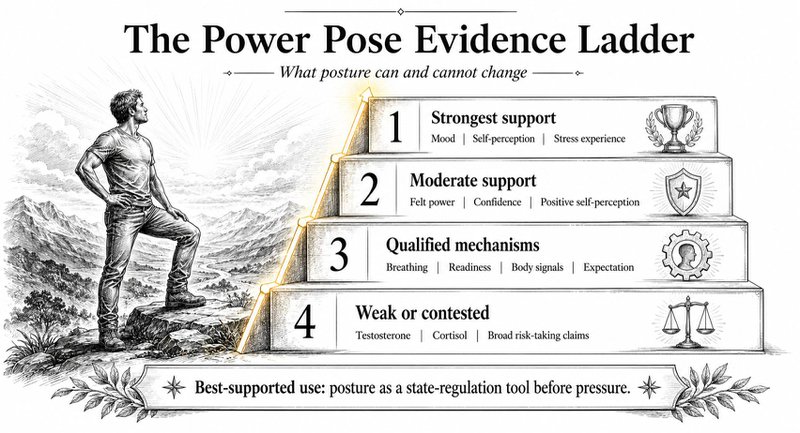
The strongest article on power poses should not treat every claim as equal. The evidence belongs on a ladder.
- Strongest: slumped or contractive posture can worsen mood, negative thinking, self-focus and stress experience, while upright posture can support mood and self-esteem under challenge.
- Moderate: expansive or upright postures may increase felt power, confidence or positive self-perception for some people in some contexts.
- Qualified: posture may work through breathing mechanics, autonomic activation, interoception and expectation, but there is no single simple pathway.
- Weak or contested: power poses reliably produce immediate testosterone, cortisol or broad risk-taking changes.
Upright posture has been linked with higher self-esteem, better mood and reduced self-focus under stress. Stooped posture has been linked with poorer mood recovery and more negative thoughts. Upright posture has also been associated with improved mood and processing speed compared with stooped posture in experimental work.4Nair, S., Sagar, M., Sollers, J.J. III, Consedine, N.S. and Broadbent, E. (2015) 'Do slumped and upright postures affect stress responses? A randomized trial', Health Psychology, 34(6), pp. 632-641. Available at: https://doi.org/10.1037/hea0000146; Veenstra, L., Schneider, I.K. and Koole, S.L. (2017) 'Embodied mood regulation: The impact of body posture on mood recovery, negative thoughts, and mood-congruent recall', Cognition and Emotion, 31(7), pp. 1361-1376. Available at: https://doi.org/10.1080/02699931.2016.1225003; Awad, S., Debatin, T. and Ziegler, A. (2021) 'Embodiment: I sat, I felt, I performed: Posture effects on mood and cognitive performance', Acta Psychologica, 218, 103353. Available at: https://doi.org/10.1016/j.actpsy.2021.103353.
That is enough to matter.
You do not need a guaranteed hormone spike to justify using posture before pressure. You only need a better state than collapse.
Why power poses work best when they reduce collapse
The internet made power posing sound like theatre. Stand like a superhero. Take up space. Become dominant.
That is not the most useful frame.
The more useful frame is this: stop carrying yourself like defeat before the moment has even begun.
A collapsed body does not only communicate with other people. It communicates with you. Fold the chest. Drop the gaze. Hold the breath. Narrow the body. Then notice what happens to thought. The task feels heavier. The room feels larger. Action feels further away.
Now reverse it without becoming rigid. Stack the body. Open the chest. Let the breath move. Lift the gaze. Plant the feet. You may not become fearless. You may not become dominant. But you often become more available.
That is the useful truth.
Sometimes the first act of self-mastery is refusing to let the body vote against the next action.
Why posture can change state even if hormones stay contested
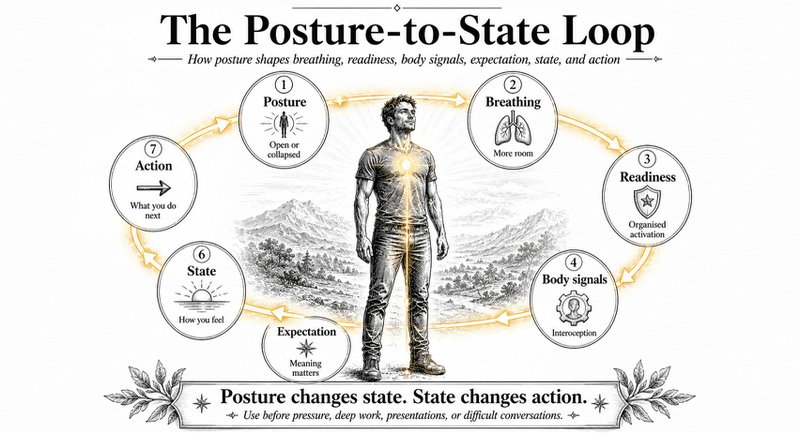
Posture can change state because state is not only mental. It is physical, cognitive, emotional and interpretive at the same time. The body is not separate from the work of courage. The body is one of the places courage has to pass through.
1. Posture changes breathing
Slumped posture can mechanically change how the breath moves. Research comparing upright and slouched sitting found that slouched sitting reduced respiratory muscle strength compared with upright sitting in healthy young men.5Albarrati, A., Zafar, H., Alghadir, A.H. and Anwer, S. (2018) 'Effect of upright and slouched sitting postures on the respiratory muscle strength in healthy young males', BioMed Research International, 2018, 3058970. Available at: https://doi.org/10.1155/2018/3058970.
You can test this in seconds. Collapse your chest and breathe. Then lengthen the spine, widen the collarbones and breathe again. The second breath usually has more room.
This is not mystical. Posture changes breathing. Breathing changes state. State changes action.
2. Posture changes readiness
Many people assume a power pose works by making the body calm. That may be the wrong model. In one study, high-power poses increased felt power and reduced perceived stress relative to low-power poses, but cardiac vagal activity decreased during the high-power poses. That suggests immediate activation rather than simple relaxation.6Laborde, S., Strack, N. and Mosley, E. (2019) 'The influence of power posing on cardiac vagal activity', Acta Psychologica, 199, 102899. Available at: https://doi.org/10.1016/j.actpsy.2019.102899.
This matters because pressure does not always ask for tranquillity. Before a hard conversation, interview, presentation or workout, you may not need to feel sedated. You may need organised activation. For decision-heavy days, combine this with cognitive load budgeting.
Courage is not the absence of arousal. Often, it is arousal with direction.
For a deeper nervous-system bridge, read Heart Rate Variability in the Self Matrix.
3. Posture changes how you sense yourself
Interoception is the ability to sense internal bodily signals. A pilot study found that a single power-posing session increased interoceptive accuracy and subjective feelings of power, although this evidence is preliminary and should not be overstated.7Weineck, F., Messner, M., Hauke, G. and Pollatos, O. (2019) 'Improving interoceptive ability through the practice of power posing: A pilot study', PLOS ONE, 14(2), e0211453. Available at: https://doi.org/10.1371/journal.pone.0211453.
This is where power poses become more interesting than body-language advice. The pose gives you feedback. It asks: are you folded, braced, hidden, breathless, tense, collapsed or ready?
The answer matters because the body can reveal the state before the mind has language for it.
4. Posture changes expectation
Some people dismiss posture rituals by saying, “It is just placebo.” That is too shallow.
Placebo and nocebo effects show that positive and negative expectations can produce real effects in experience and physiology. That does not rescue weak hormone claims. It does show that expectation, meaning and ritual can matter in the body.8Colloca, L. and Barsky, A.J. (2020) 'Placebo and nocebo effects', New England Journal of Medicine, 382(6), pp. 554-561. Available at: https://doi.org/10.1056/NEJMra1907805.
This is why the article on placebo and nocebo effects in the Self Matrix belongs beside this one. Expectation is not fake just because it is mental. The mind is embodied. Meaning has consequences.
The serious move is not to pretend expectation is irrelevant. The serious move is to use expectation without lying to yourself.
A 90-second power pose reset before pressure
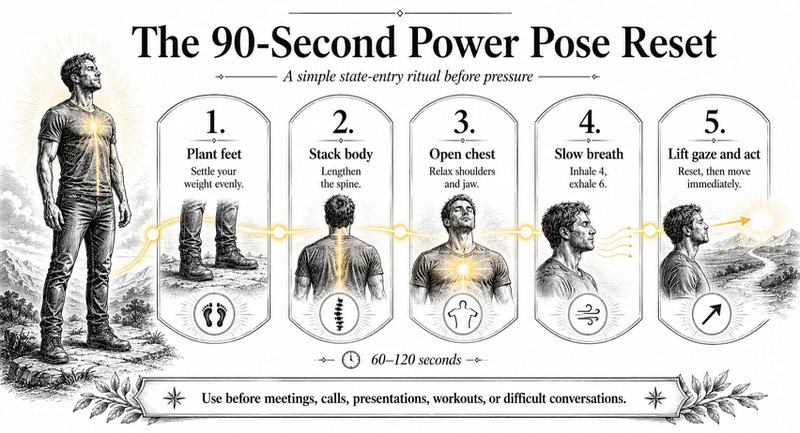
Use this before a meeting, call, interview, workout, presentation, negotiation, deep work block or difficult conversation. The goal is not to become someone else. The goal is to stop entering pressure from collapse.
- Plant both feet. Stand or sit with both feet grounded. Let your weight settle evenly. Do not lock the knees.
- Stack the body. Lengthen through the crown of the head. Let the ribs sit over the pelvis. Lift the sternum slightly without forcing the chest forward.
- Open the front line. Widen across the collarbones. Let the shoulders move gently back and down. Uncross the arms. Unclench the jaw.
- Choose organised openness. Hands on hips, arms resting wide, a low victory shape, or a calm upright seated posture can all work. Choose the posture that creates steadiness, not performance theatre.
- Breathe with a longer exhale. Take four to six slow breaths. Try inhaling for four counts and exhaling for six. The goal is smoother breath, not maximal breath.
- Lift the gaze. Bring the eyes to horizon level. Let the visual field widen. A lowered gaze often keeps the body in contraction.
- Give the body one directive. Use one cue: steady, ready, speak clearly, one thing at a time, or meet the moment.
- Move immediately. Do not turn the reset into avoidance. Reset the state, then act.
This is the difference between a ritual and a hiding place: a ritual prepares action. A hiding place delays it.
Three fast-acting tools to boost focus, energy, and discipline in the next 72 hours.
When to use power poses
Use power poses when the next action asks more from you than your current state is offering.
- Before a meeting where you need to speak clearly.
- Before a call you are tempted to avoid.
- Before a presentation, interview or negotiation.
- Before a workout when energy is low but the session matters.
- Before a difficult conversation where you need steadiness without aggression.
- Before a deep work block when screens, stress and open loops have pulled the body into contraction.
If the larger problem is attention collapse rather than one moment of pressure, pair this posture reset with the 72-hour focus reset. Posture can help you enter a better state, but focus also depends on sleep, environment, task clarity, recovery and interruption control. If this keeps happening beyond one pressure moment, take the Atlas Audit to see where pressure is showing up first.
What not to claim about power poses
Good tools become weaker when people overclaim them. Use power poses, but do not make them carry more than the evidence can hold. If the same pattern keeps getting misdiagnosed as a discipline problem, read The 7 Leaks High Performers Misdiagnose.
- Do not claim guaranteed hormone changes. The endocrine story is contested and should not be presented as settled.
- Do not treat power posing as therapy. A randomized study of power posing before public speaking exposure for social anxiety disorder found no evidence that it augmented exposure therapy outcomes or hormone changes.9Davis, M.L., Papini, S., Rosenfield, D., Roelofs, K., Kolb, S., Powers, M.B. and Smits, J.A.J. (2017) 'A randomized controlled study of power posing before public speaking exposure for social anxiety disorder: No evidence for augmentative effects', Journal of Anxiety Disorders, 52, pp. 1-7. Available at: https://doi.org/10.1016/j.janxdis.2017.09.004.
- Do not confuse openness with aggression. The goal is presence, not intimidation.
- Do not use posture instead of preparation. Posture may help you access your capacities. It does not build the capacities by itself.
- Do not force military stiffness. Rigidity can become another form of bracing. Aim for organised openness.
How power poses fit inside the Self Matrix
The Self Matrix is built on a simple but demanding idea: the physical, cognitive and spiritual dimensions of the self are not separate projects. They interact.
Power poses are a small example of that larger truth.
A physical change can open the breath. Breath can change state. State can change attention. Attention can change action. Action can change identity.
This is not shallow body-language advice. It is systems-based self-mastery at the scale of one moment.
When you carry yourself like defeat, you do not only show the world a signal. You also give yourself one. When you organise the body with steadiness, breath and readiness, you create a different starting point for thought and action.
The body is where clarity either begins or bleeds.
For adjacent framework treatments, see Power Poses in the Excellence Nexus and Power Poses in the CORE Compass.
Common questions about power poses
Do power poses work?
Power poses can work when you define the goal correctly. They are most defensible as a state-regulation tool for posture, breathing, mood, self-perception and readiness. They are not defensible as a guaranteed shortcut for changing hormones.
Do power poses change hormones?
The hormone claim is debated. The original study reported higher testosterone and lower cortisol after expansive poses, but later replication work and reviews did not support a broad, reliable hormone effect. The best public claim is that hormone effects remain contested.10Carney, D.R., Cuddy, A.J.C. and Yap, A.J. (2010) 'Power posing: brief nonverbal displays affect neuroendocrine levels and risk tolerance', Psychological Science, 21(10), pp. 1363-1368. Available at: https://doi.org/10.1177/0956797610383437; Ranehill, E., Dreber, A., Johannesson, M., Leiberg, S., Sul, S. and Weber, R.A. (2015) 'Assessing the robustness of power posing: no effect on hormones and risk tolerance in a large sample of men and women', Psychological Science, 26(5), pp. 653-656. Available at: https://doi.org/10.1177/0956797614553946; Körner, R., Röseler, L., Schütz, A. and Bushman, B.J. (2022) 'Dominance and prestige: Meta-analytic review of experimentally induced body position effects on behavioral, self-report, and physiological dependent variables', Psychological Bulletin, 148(1-2), pp. 67-85. Available at: https://doi.org/10.1037/bul0000356.
What is the best power pose?
The best power pose is the one that makes you feel stable, open and ready without becoming performative. For most people, that means feet grounded, spine long, chest open, shoulders relaxed, gaze lifted and breathing smooth. Hands on hips can work. A calm upright seated posture can also work.
How long should you hold a power pose?
Hold the posture for 60 to 120 seconds. That is long enough to notice breath, posture, gaze and state, but short enough to use before real pressure. The goal is not to keep posing. The goal is to enter action from a cleaner state.
Are power poses just placebo?
Even if some of the benefit comes through expectation, that does not make it fake. Placebo and nocebo research shows that expectations can influence real experience and physiology. The honest approach is to use expectation as one mechanism without pretending the hormone evidence is stronger than it is.11Colloca, L. and Barsky, A.J. (2020) 'Placebo and nocebo effects', New England Journal of Medicine, 382(6), pp. 554-561. Available at: https://doi.org/10.1056/NEJMra1907805.
Can power poses help before an interview or presentation?
Power poses may help before an interview or presentation by improving posture, opening breathing, reducing visible collapse and increasing readiness. They should be paired with preparation, rehearsal and clear thinking. Presence is easier to access when the body is not fighting the moment.
Can power poses help anxiety?
Power poses may help some people regulate state before pressure, but they are not a treatment for anxiety disorders. If anxiety is persistent, severe, impairing or escalating, posture practice should not replace professional support.
Final answer: power poses work as a state tool
The real correction is simple: power poses are not a magic spell, but posture is not irrelevant.
Your body is not separate from your mind.
Stand taller. Open the chest. Lift the gaze. Breathe like someone who is ready. Notice what changes.
Call it embodiment. Call it psychology. Call part of it expectation. The label matters less than the leverage.
Posture changes breathing. Breathing changes state. State changes action. Action changes results.
Not always dramatically. Not always hormonally. Not always in a way that satisfies every debate.
Enough to use.
Sometimes the first act of self-mastery is refusing to carry yourself like defeat.
For a broader system of practical tools for focus, energy and discipline, start with the Atlas Focus Kit.
Enter your email and get instant access to three practical tools you can apply in 10 minutes.

