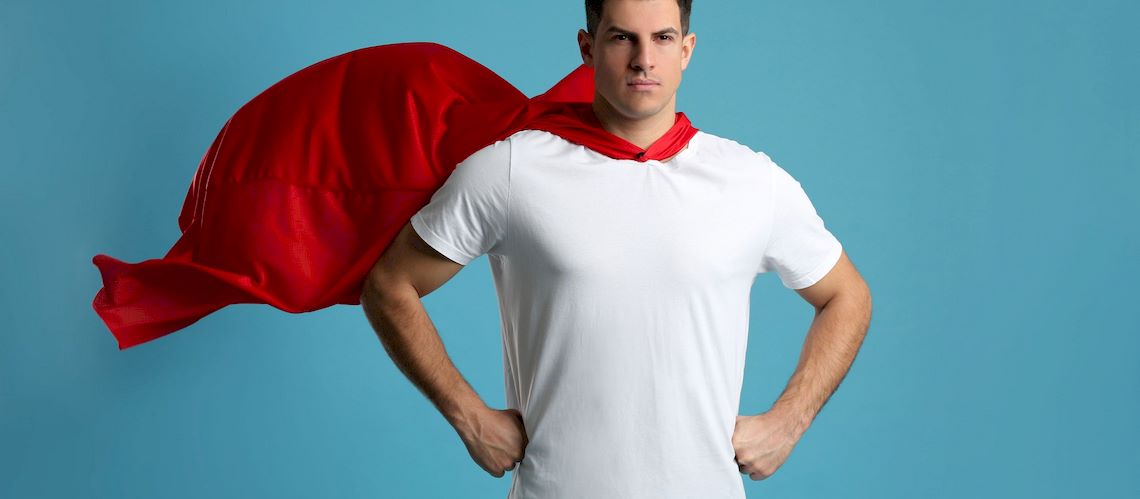
Power poses are one way of exploring the relationship between physical and mental well-being. The Self Matrix treats this relationship as part of developing the whole person: the body belongs in our efforts to think clearly, communicate honestly and act with purpose. Paying attention to how we carry ourselves gives us a practical place to begin.
Choose a power pose for the thing you are about to do. A private pause before a difficult conversation calls for a different position from one you can comfortably hold while listening to another person. The value of this preparation depends on what you bring it to. Opening your posture before a conversation makes sense as part of preparing to speak and listen; the conversation itself is where that preparation has to become useful.
This guide keeps five familiar power poses and shows how to choose among them, adapt them and notice what happens. For the fuller research discussion, including the disputed hormone claims, read Do Power Poses Work?
What to ask of a power pose
Power poses are open, expansive body positions associated with power or confidence. The familiar hands-on-hips stance is one example. An upright seated position, with room for the arms and an unforced breath, can be a less conspicuous place to start.
Use the posture to investigate something you can actually notice: whether you are gripping the chair, holding the shoulders up, looking down or making yourself uncomfortable while preparing to speak. Then make an adjustment. You do not need to decide that a particular pose is the best one for everyone before finding out whether it is useful to you.
Keep the test connected to the task. Feeling imposing before a conversation is of little value if you then struggle to listen. Feeling perfectly calm is not a requirement for asking a necessary question. Choose the quality the moment needs, and let the posture serve it.
Five power poses and how to choose one
The five names describe ways to stand or sit; research does not establish a distinct psychological benefit for each one. Choose according to the situation and the movement available to you. Stay within a comfortable range, adapt around mobility limitations, and leave out a position that causes pain or strain.
| Posture | How to try it | Choose or adapt it |
|---|---|---|
| 1. The Wonder Woman Pose | Stand with feet comfortably apart and hands on your hips. Let the chest remain open without pushing it forward; keep the head level. | Try it during a private pause before a call or presentation, while rehearsing the point you want to make. The hands provide a simple point of contact. If your elbows feel forced outward, bring them in. |
| 2. The Victory Pose | Stand or sit with arms raised into a comfortable V. Keep the shoulders free of strain and the head in a natural position. | Choose it when you have space and raising the arms feels comfortable. A lower V is an option. If overhead movement is uncomfortable, use the seated posture instead. |
| 3. The CEO Pose | Sit with your feet supported and allow the arms to rest comfortably on the chair or in front of you. Give the torso room without leaning into an exaggerated arch. | Choose this when you need a position you can carry into the activity itself. You can remain seated while reading your notes, listening or beginning a conversation, and adjust without interrupting what you are doing. |
| 4. The Starfish Pose | Stand with arms and legs spread into a comfortable, broad shape. Keep your balance and use only the space available. | Reserve it for a brief pause in a private setting where you can move freely. Try the broader shape, notice how it feels, then return to the position your next activity requires. |
| 5. The Expansive Lean | Lean back slightly in a stable chair, with feet supported and arms resting comfortably on armrests or a suitable surface. | Try it during a pause before returning to a task. Avoid tipping the chair or taking over someone else’s space. When the conversation starts, adjust to a position in which you can attend to the other person. |
The useful choice may be the least dramatic one. If you are already seated at a table, you can put both feet down, release your grip and give yourself room to breathe. A posture you can actually use in the moment has more practical value than an elaborate pose you will never choose.
Free Starter Kit
Get the Atlas Starter Kit
Three fast-acting tools to boost focus, energy, and discipline in the next 72 hours.
Make the posture serve the next action
Begin with the action, because it gives the practice a purpose. You might need to ask for something, present a proposal, return to a difficult piece of work or discuss a recurring disagreement with someone you love. Those situations ask different things of you. Presence can include firmness, patience, curiosity and warmth.
A worked example: preparing for a difficult conversation
Imagine you need to raise a problem with someone close to you. You have thought through the issue, but while rehearsing it you notice that you are gripping your hands and bracing your shoulders. You want to be honest about something that matters, and you care about the person who needs to hear it. Preparing well means finding a way to express the problem clearly, with enough gentleness to invite a response and enough honesty that the problem is actually expressed.
Choose the seated option. Put your feet somewhere supported, let your hands rest and find a position you can hold without effort. Take a few comfortable breaths. Notice whether the gripping eases and whether you can say your opening point aloud without rushing. If spreading the arms makes you feel more performative, bring them closer. Practise the opening in a position you can also use when the other person is there.
Then begin the conversation. Afterwards, examine what happened: did you express the concern you meant to raise, listen to the response and stay with the discussion? If you spoke clearly at first but began rushing when the person disagreed, you have found something specific to work on. Next time, prepare for that point as well as for the opening. You can practise pausing, hearing the objection and answering it, while noticing whether you have started gripping your hands again. The experience gives the next attempt a direction.
A brief personal comparison can help you decide what to keep. Try a comfortable ordinary position on one occasion and an open position on another, noticing both your experience and what you actually do. This cannot isolate posture from preparation, expectation or the situation. Its practical value is in learning which preparation you will use again and what still needs attention. Keep what helps, make the next adjustment and bring it back into the conversation or task.
For an existing step-by-step posture and breathing routine, use the 90-second reset in the companion article. If the difficulty is that your whole day leaves too little capacity for the next decision, cognitive load budgeting addresses that wider problem.
What the research supports, and what it does not
The original power-posing experiment reported changes in felt power, hormones and risk-taking. Those findings helped make a brief posture change sound unusually powerful. Later work challenged that package of claims; the Ranehill study did not find effects on hormones or risk tolerance. A pose should not be presented as a reliable hormone intervention.1Carney, D.R., Cuddy, A.J.C. and Yap, A.J. (2010) ‘Power posing: brief nonverbal displays affect neuroendocrine levels and risk tolerance’, Psychological Science, 21(10), pp. 1363–1368. Available at: https://doi.org/10.1177/0956797610383437; Ranehill, E., Dreber, A., Johannesson, M., Leiberg, S., Sul, S. and Weber, R.A. (2015) ‘Assessing the robustness of power posing: no effect on hormones and risk tolerance in a large sample of men and women’, Psychological Science, 26(5), pp. 653–656. Available at: https://doi.org/10.1177/0956797614553946.
A 2022 meta-analysis pooling 88 studies found effects on self-reported outcomes, but did not find support for physiological effects. Its behavioural findings were sensitive to publication bias and outliers.2Körner, R., Röseler, L., Schütz, A. and Bushman, B.J. (2022) ‘Dominance and prestige: Meta-analytic review of experimentally induced body position effects on behavioral, self-report, and physiological dependent variables’, Psychological Bulletin, 148(1–2), pp. 67–85. Available at: https://doi.org/10.1037/bul0000356. Take a change in experience seriously, while keeping the separate question of whether the posture improves what you actually do.
Even feeling less stressed does not establish that every physiological measure moves towards relaxation. In a study of 56 participants, poses were paired with role descriptions. The high-power condition showed higher felt power and lower perceived stress than the low-power condition, while cardiac vagal activity decreased during the high-power positions. The researchers interpreted the immediate pattern as activation rather than the calming response they had predicted.3Laborde, S., Strack, N. and Mosley, E. (2019) ‘The influence of power posing on cardiac vagal activity’, Acta Psychologica, 199, 102899. Available at: https://doi.org/10.1016/j.actpsy.2019.102899.
There are also early findings on awareness of bodily signals. A pilot study of 41 healthy women reported improved heartbeat-tracking performance and greater felt power after a power-posing session. Its small, specific sample and lack of a neutral-posture comparison limit what we can conclude. It does not establish that these five poses improve emotional resilience or treat a body-image problem.4Weineck, F., Messner, M., Hauke, G. and Pollatos, O. (2019) ‘Improving interoceptive ability through the practice of power posing: A pilot study’, PLOS ONE, 14(2), e0211453. Available at: https://doi.org/10.1371/journal.pone.0211453.
Keep three things separate: a posture that you find comfortable, a change in how you feel, and an improvement in the task you care about. They may accompany one another, but one does not prove the others. That distinction leaves room to experiment without asking a small adjustment to explain your whole performance.
If you are trying power poses for anxiety
Everyday nerves before a conversation and a diagnosed anxiety disorder are different situations. In a randomized study of 73 people with social anxiety disorder, power posing before a public-speaking exposure session did not improve the measured outcomes compared with submissive posing or rest. The study found no added benefit for hormone levels or exposure-therapy outcomes.5Davis, M.L., Papini, S., Rosenfield, D., Roelofs, K., Kolb, S., Powers, M.B. and Smits, J.A.J. (2017) ‘A randomized controlled study of power posing before public speaking exposure for social anxiety disorder: No evidence for augmentative effects’, Journal of Anxiety Disorders, 52, pp. 1–7. Available at: https://doi.org/10.1016/j.janxdis.2017.09.004.
You can try a comfortable posture as part of ordinary preparation, but it should not be sold to you as treatment or used to replace appropriate care. If anxiety is persistently limiting your life, seek qualified support. There is no failure in needing more than a change of position.
The body belongs in the larger picture
The interplay between the physical body and mental life has ancient philosophical roots. In On the Soul, Aristotle understands soul as the form or actuality of a living body. His argument treats life through the relation between bodily capacities and their activity, rather than treating a person as a mind merely carried around by matter.6Aristotle (c. 350 BCE) On the Soul, Book II, Part 1. Translated by J.A. Smith. The Internet Classics Archive. Available at: https://classics.mit.edu/Aristotle/soul.2.ii.html (Accessed: 2 October 2026).
In the Nicomachean Ethics, flourishing concerns activity in accordance with virtue across a complete life. That gives the discussion a richer destination than simply appearing powerful.7Aristotle (c. 350 BCE) Nicomachean Ethics, Book I, Part 7. Translated by W.D. Ross. The Internet Classics Archive. Available at: https://classics.mit.edu/Aristotle/nicomachaen.1.i.html (Accessed: 2 October 2026). These are philosophical connections, not experimental evidence for power posing. Their value here is the question they return us to: what kind of action is this preparation helping you take?
Within the Self Matrix, the physical, cognitive and spiritual dimensions of life belong in the same conversation. A posture can be a small physical act; the thought you bring to it and the purpose you serve give that act its place. Preparing to negotiate, to apologise, to speak up or to listen with patience may involve a similar adjustment of the body, while asking something very different of the person.
Choose the position, then meet the moment
Keep the pose that helps you prepare, adapt the one that feels forced, and judge the practice by its place in your actions. You do not have to look powerful to ask a good question, hold a difficult boundary or give someone your full attention.
Choose one ordinary moment today and decide what it asks of you. Prepare for it, give your body a place in that preparation, and begin. Afterwards, examine what you actually did and what you would change. The next time you face that situation, you will have more than a posture to repeat. You will have an experience to learn from.